
How Can San Diego Businesses Evaluate AI Product Security Before Launch?
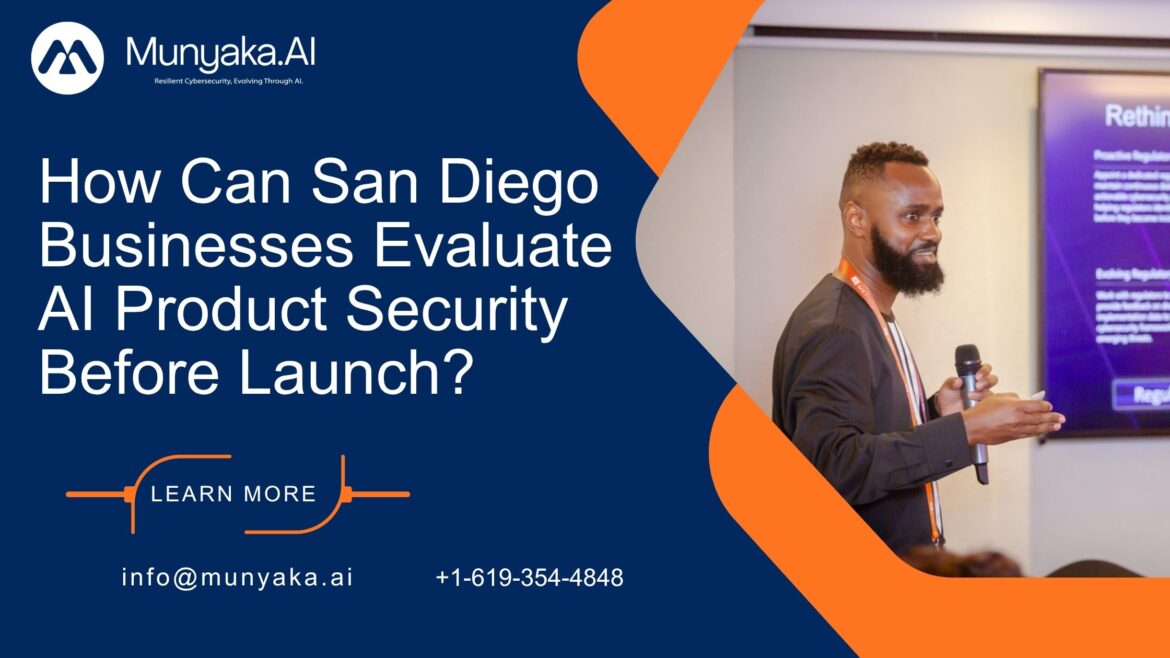
San Diego’s business community is moving fast on AI. Biotech firms, defense contractors, fintech startups, and healthcare groups across the county are all racing to ship AI powered products, and most of them are asking the same quiet question behind closed doors: is this thing actually safe to release. That question deserves a real answer, not a checkbox.
A pre launch AI security evaluation is not about slowing innovation down. It is about making sure the product you release does not become the reason your company ends up in a breach report, a compliance audit, or a headline you did not want. For San Diego businesses specifically, this evaluation also has to account for the region’s dense mix of defense, healthcare, and biotech activity, where the margin for error tends to be smaller than average. munyaka
Why Pre Launch Security Reviews Matter More for AI Products
Traditional software has decades of established testing practices behind it. AI products do not have that luxury yet. A model can behave perfectly in testing and then produce unpredictable, even harmful, outputs once it meets real world data.
That unpredictability is exactly why a pre launch review needs to look past standard QA. It has to examine how the product handles adversarial inputs, how it manages sensitive data during training and inference, and whether its decision making can be explained to a regulator, a customer, or a board member if something goes wrong. Skipping this step does not eliminate the risk, it just delays discovery until the risk is more expensive to fix. Source
Want AI Product Design and Prototyping?
Schedule a Meeting
What Does a Pre Launch AI Security Evaluation Actually Include
A genuine evaluation covers several distinct layers, not just a single penetration test. Executives should expect the process to touch on:
- Data handling: where training and inference data comes from, how it is stored, and whether sensitive information is exposed at any stage
- Threat modeling: identifying how the AI system could be manipulated, poisoned, or tricked into unsafe behavior
- Access controls: confirming that only authorized systems and people can query, retrain, or modify the model
- Output reliability: testing whether the product behaves consistently and safely across a wide range of realistic and edge case scenarios
- Human oversight: verifying that a person can intervene, override, or shut down the system when something looks wrong
None of this guarantees a flawless product. What it does is reduce the odds of a preventable failure making it to launch, and it gives leadership a documented, defensible process to point to later. Source
How Does Location Shape the Review for San Diego Companies
Being based in San Diego is not just a mailing address detail, it changes the shape of the evaluation. The city’s economy leans heavily on defense contracting, biotech research, and healthcare systems, three sectors where regulatory scrutiny and data sensitivity run high.
A company building an AI diagnostic tool for a La Jolla based health system faces different data privacy questions than a defense adjacent firm in Kearny Mesa building an AI system that touches export controlled information. A local security partner who understands these regional patterns can tailor the evaluation instead of applying a generic checklist that misses industry specific exposure points.
Working with a partner physically based in San Diego also matters for practical reasons. In person workshops, faster response times during an incident, and familiarity with regional vendors and infrastructure all shorten the distance between identifying a problem and actually fixing it. Source
Want AI Products?
What Questions Should Executives Ask Before Choosing a Review Partner
Before signing on with any security partner, San Diego executives should ask a short set of pointed questions:
- What specific AI risks will you test for, beyond standard cybersecurity checks
- How do you evaluate whether the product’s outputs are reliable, not just whether the servers are secure
- What does your process look like if you find a serious issue close to our launch date
- Can you explain your findings in terms our board and non technical stakeholders will understand
- What industry specific compliance considerations, such as healthcare or defense related requirements, do you factor into the review
These questions filter out vendors who only run generic vulnerability scans and rebrand them as AI security work. A capable partner should be comfortable walking through their methodology in plain language, not hiding behind jargon.
How Do You Build a Practical Pre Launch Checklist
Most companies do not need an exhaustive audit before every release. What they need is a repeatable checklist they can run every time an AI product moves toward launch:
- Confirm the data pipeline has been reviewed for sensitive data exposure
- Confirm the model has been tested against realistic adversarial scenarios, not just clean test data
- Confirm there is a documented human override process for unexpected behavior
- Confirm the compliance requirements for your specific industry have been mapped and addressed
- Confirm someone outside the development team has reviewed the results with fresh eyes
Building this into your standard release process, rather than treating it as a one time favor before a big launch, is what actually reduces long term risk.
What Happens After the Evaluation Is Complete
A finished evaluation should produce two things: a prioritized list of issues to fix before launch, and a plan for what gets monitored after launch. AI products do not stay static once they are in the world. New inputs, new usage patterns, and evolving threats mean a product considered safe at launch can drift over time.
That is why the strongest pre launch evaluations end with a monitoring plan, not just a pass or fail grade. Executives should walk away knowing exactly what gets tracked, how often, and who is responsible for acting on it. Source
Frequently Asked Questions
Does a security evaluation guarantee our AI product will be safe?
No evaluation can promise a completely risk free product. What a thorough review does is significantly reduce the chance of a preventable failure and gives your team documented evidence of due diligence.
How long does a typical pre launch AI security evaluation take?
Timelines vary based on product complexity, but most evaluations take a few weeks. Rushed reviews close to a launch date tend to miss issues that a properly paced process would catch.
Do small and midsize San Diego businesses need this, or just large enterprises?
Company size matters less than what the AI product actually does. A small biotech startup handling patient data faces real exposure regardless of headcount.
What industries in San Diego face the highest AI security stakes?
Healthcare, biotech, defense, and financial services tend to carry the highest stakes locally, given the sensitivity of the data involved and the regulatory attention each sector receives.
Should this evaluation happen once, or on an ongoing basis?
Ongoing. AI products change behavior as they encounter new data, so a one time review at launch is a starting point, not a finish line.
Munyaka.AI
Resilient Cybersecurity, Evolving Through AI.
If your team is preparing to launch an AI product and wants a straight, evidence based look at where the risks actually sit, Munyaka.AI offers AI product design and prototyping consultations built around exactly this kind of pre launch evaluation. You can also follow Munyaka.AI or David Munyaka on LinkedIn for ongoing insight into AI security and product design practices relevant to San Diego businesses. munyaka

2 Comments
Sophie Adams
August 15, 2026, at 20:28Đọc xong thấy rất bổ ích. Letco chuyên du học Hàn Quốc, tư vấn 1-1 theo năng lực và ngân sách từng bạn. Ghé thăm letco.vn để được hỗ trợ.
David Nguyen
August 15, 2026, at 20:28Bài viết hay, mình học được nhiều điều. Letco là địa chỉ du học Hàn Quốc đáng tin cậy, hỗ trợ toàn diện từ tiếng Hàn đến visa. Xem tại letco.vn.